← Back to dashboard
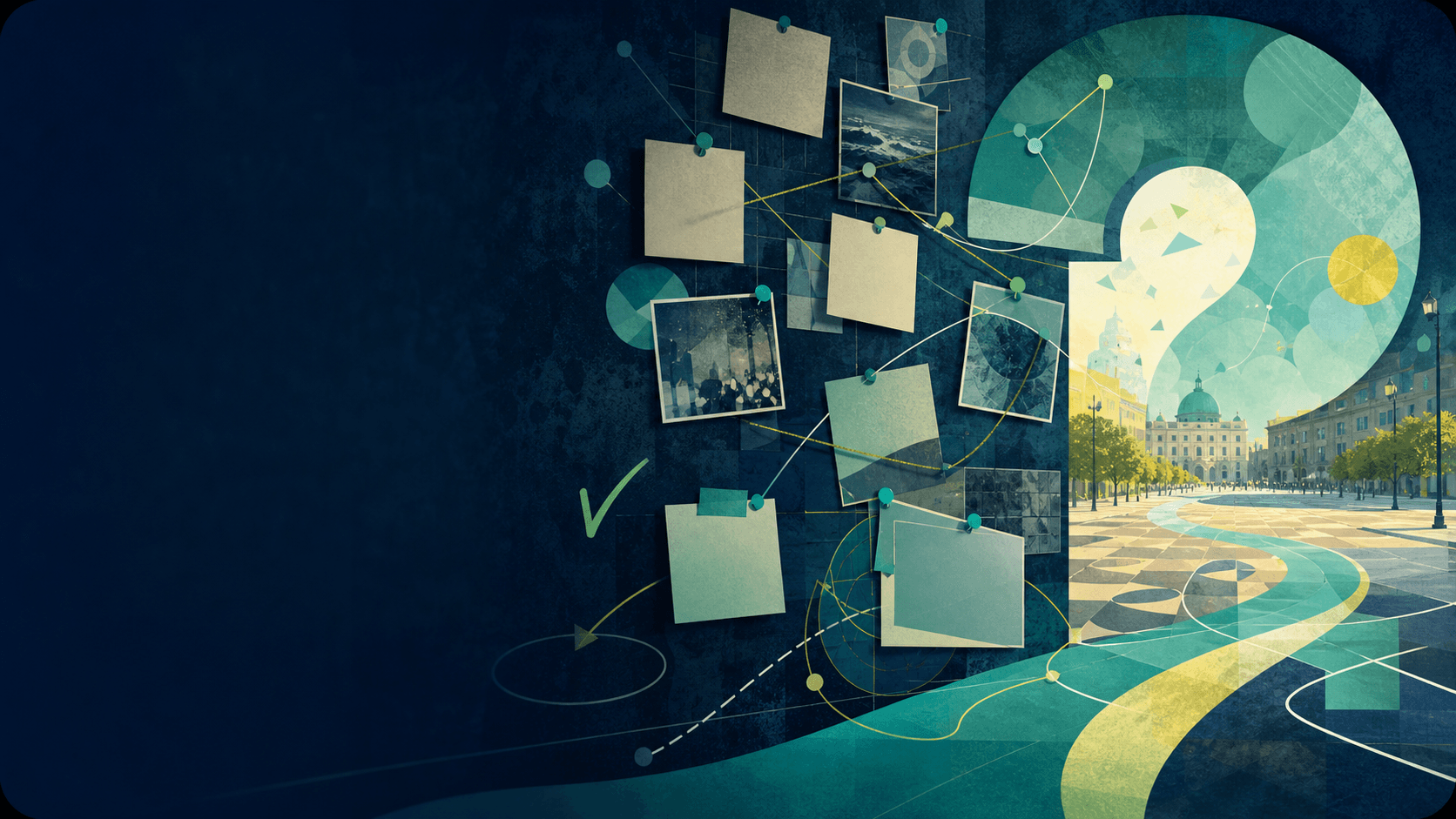
An inquiry wall leads from questions through evidence to a public square with revision marks.

Independent Inquiry and Public Contribution

Develop open questions, traceable evidence, bounded claims, public contributions, and revision through oral defence.

Learning goals

  • Match methods and claims while distinguishing observation, report, interpretation, and proposal.
  • Synthesize divergent evidence and state uncertainty with usable boundaries.
  • Adapt and defend an inquiry publicly without overstating what it proves.
  • Use AI for support, not finished answers.

Reading support

Answer a question to unlock the next source section. Options reshuffle after a wrong answer.

Guided reading mode is off for this student.

The Question That Survived

Overview

Independent inquiry is often described as finding an answer. In practice, the hardest work may be deciding what the evidence can support, what remains uncertain, and how a conclusion should change when it enters public life. As you read, track how one student's question, method, claim, and audience alter one another.

Read

The Question That Survived

1. A conclusion looking for evidence

Lea began with a conclusion. The harbour path was empty after dark because people felt unsafe.

The path connected the station to two residential areas, yet in winter many people used a longer road beside the shops. Several lamps appeared dim. Lea could already imagine her recommendation: brighter lighting would make the path safer.

Her first question merely disguised that answer: why did poor lighting cause residents to avoid the path? The wording contained a cause and judgement she had not established. It could collect agreement but gave disagreement no clear place to matter.

A focused question is not a prediction written with a question mark. It should create a bounded uncertainty that evidence can genuinely reduce.

2. Making the question answerable

Lea separated what she had noticed from what she had inferred. She had seen few people on the path during three evening walks. She had not measured use, compared times, asked travellers, inspected the lamps, or examined other routes. Emptiness was an observation. Fear was one possible explanation.

She revised the question: What factors appear to influence use of the harbour path between the station and North Quay on winter weekday evenings?

The new version named a place, period, and behaviour without deciding the cause. It also exposed a limit: influential factors would not prove causation. Lea could investigate patterns, accounts, and design conditions, but not experimentally rearrange the town.

The question became stronger when its ambition became more exact.

3. A method for each kind of claim

One method could not answer every part of the question. Observation could show how the path was used, but not what absent travellers thought. Interviews could reveal participants' reasons, while public documents could explain recorded plans. Neither represented every traveller's experience.

Lea designed a small mixed inquiry. She would observe both the harbour path and the shop road at matched times, record visible conditions without identifying individuals, invite adult volunteers to describe route choices, and examine the fictional town's published path plan and maintenance notices.

She wrote what each method could support: counts for observed use, interviews for participants' stated reasons, and documents for official aims and recorded actions. None could establish the motives of people she had not spoken to.

Method was not a decorative section placed before the findings. It set the ceiling on every later claim.

4. Keeping a traceable trail

At first Lea's notes were a heap of useful-looking fragments. She remembered a remark but not which interview it came from. She had copied a sentence from a notice without recording its date. One evening's observations included weather; another did not.

She rebuilt the trail. Each document received a title, issuer, date, location, and access note. Each observation received a time, route, conditions, and agreed category system. Interview notes used anonymous codes and separated what participants reported from Lea's interpretation. A claim table linked every draft statement to the material that supported, complicated, or failed to support it.

Traceability did not make the sources true. Documents could omit problems, participants could misremember, and Lea could categorise inconsistently. The trail made those weaknesses inspectable and showed how much weight each source carried.

Citation was part of the reasoning, not a final layer of punctuation.

5. The pattern that interrupted the story

The observations disturbed Lea's original explanation. The harbour path was not simply unused. At the beginning of the evening, commuters crossed it in clusters after trains arrived. Later, use fell sharply. On two rainy evenings, the covered shop road attracted more walkers even where its route was longer. Cyclists used the harbour path more consistently than pedestrians.

Interviews complicated the picture. Some participants mentioned darkness; others emphasised wind, closed destinations, uncertain maintenance, or shopping on the way home. Several distinguished feeling exposed from expecting a specific danger.

Lea could have treated the inconvenient material as noise. Instead, she changed the organising claim. Route choice appeared to emerge from an interaction among visibility, weather exposure, timing, destination, habit, and perceived options. Lighting remained relevant, but it was no longer the whole mechanism.

A serious inquiry allows evidence to reorganise the explanation.

6. Synthesis instead of stacking

Lea's first findings section moved source by source: document, interview, observation, then another document. It displayed labour but left the reader to build the argument.

She revised by organising around claims. One section examined changing use across the evening and brought observations into contact with transport timing. Another compared the meanings participants attached to darkness, exposure, and convenience. A third tested official design aims against maintenance records and observed conditions.

The sources did not all perform the same job. An observation established a pattern in Lea's sample. An interview suggested a possible explanation. A planning document clarified intended function. When the materials aligned, the claim became better supported. When they diverged, the difference became a finding rather than an error to hide.

Synthesis meant constructing a relationship among sources, question, and claim. It did not mean blending every voice into false agreement.

7. Uncertainty with edges

Lea worried that naming limitations would make the inquiry sound weak. Her teacher asked her to distinguish weakness from boundary.

The inquiry covered a few winter weekday evenings, not weekends, summer, or every weather condition. Volunteers did not represent all path users. Observations described visible actions, not emotions. Documents showed recorded actions, not every decision behind them.

Those boundaries defined what the work could contribute. Lea's evidence supported a multi-factor explanation in the studied setting, not a claim about every resident or a guaranteed intervention.

She also named what evidence could extend the inquiry: seasonal comparisons, accessibility review, more systematic maintenance data, and participation from people whose journeys differed from those already represented.

Useful uncertainty identifies both the limit and the next informative move.

8. From school product to public contribution

For assessment, Lea needed a clear account of question, method, evidence, and revision. A public audience also needed a reason to care, a navigable form, and proportionate recommendations.

Her public brief visualised the evening pattern, explained limits plainly, and proposed a winter trial rather than a permanent solution. It combined a lighting review, clearer maintenance information, and a sheltered stopping point. Each proposal was tied to a finding and an observable consequence.

Lea reduced technical detail while preserving the distinction between evidence, interpretation, and proposal. The full method and source trail remained available for inspection.

Public contribution required accessibility and accountability at the same time.

9. The oral defence

At the town meeting, the hardest question asked why officials should act on a limited sample.

Lea resisted the temptation to sound more certain. She explained that the evidence did not justify a town-wide claim or an expensive permanent redesign. It did justify testing a bounded response to several observed and reported barriers. The limited sample shaped the scale of the recommendation.

Another question asked whether improved lighting might increase brightness for nearby homes without changing route use. Lea had not investigated that effect. She recorded it as a missing stakeholder issue and revised the trial to include resident feedback and a review point.

The defence tested whether Lea understood her evidence's reach, could explain her choices, and knew when to revise rather than rebut.

10. The surviving question

Lea's final portfolio preserved the abandoned title, the biased first question, inconsistent notes, method changes, claim table, peer comments, and revised public brief. The record showed that the strongest version had not appeared fully formed.

Her inquiry did not prove that the harbour path was unsafe, that brighter lamps would solve avoidance, or that every traveller wanted the same route. It produced a narrower and more defensible contribution: under the conditions studied, route use varied with several interacting features, and a reversible winter trial could test responses without pretending that the answer was settled.

The question survived because it changed. It became less useful as a container for Lea's first belief and more useful as a discipline for noticing what she did not yet know.

Independent inquiry earns trust through that discipline. A credible contribution does not display certainty at every stage. It makes the path from question to claim visible, matches methods to the claims they can support, allows evidence to alter the explanation, and gives an audience both a reason to act and a way to inspect the grounds for action.

> Keep this idea: Inquiry becomes credible when its question is genuinely open, its evidence is traceable, its claims stay within the reach of its methods, and its public form makes both value and uncertainty visible.
Exercises for this text

Source analysisCore path

Independent inquiry

Choose the strongest answer, then identify the evidence and limitation that support it.

  1. Why is Lea's first question not genuinely open?

    Choose one

  2. What does method-claim fit set?

    Choose one

  3. What does traceability provide without guaranteeing truth?

    Choose one

  4. Why is the winter trial proportionate?

    Choose one

Practice

Inquiry defence conference

Prepare a fictional, non-private inquiry portfolio with a bounded question, method-claim map, source trail, uncertainty boundary, public format, and oral-defence questions. Record one revision caused by challenge.

Optional visual planning help

Word cloud

questionpublicsourcedefencechallengeclaiminquirytrailformatmethodsclaimsboundaryrevisionlimitation

Mind map

1. Claim

  • → My question is bounded by ...
  • → This method can support ..., but not ...

2. Evidence

  • → The question does not contain a preferred answer.
  • → Every method has a stated claim ceiling.

3. Audience

  • → purpose
  • → recipient
  • → register

4. Revision

  • → Source notes are traceable and distinguish report from interpretation.
  • → The revision is substantive and preserved in the portfolio.

Support path

Build a bounded inquiry plan

What you are practising: developing an open question, matching methods to claims, keeping a traceable source trail, synthesising divergence, and revising through public challenge

Path focus: Use a fictional or public, teacher-approved case and a question-method-claim table.

What to do 1. Rewrite a topic as an open, bounded question. 2. Match two methods or source types to the claims they can support. 3. Create one complete source note and claim link. 4. State one limitation and the next informative step.

Tiny model: Biased question: ‘Why does poor lighting make the path unsafe?’ Open version: ‘What factors appear to influence use of the harbour path on winter weekday evenings?’ The revision removes an untested cause and narrows the setting.

AI boundary: AI may help you format your own notes or test whether claim and limitation are grammatically clear. It must not choose the question, invent sources or findings, conduct covert research, or write the public contribution or oral defence.

Sentence starters

  • My question is bounded by ...
  • This method can support ..., but not ...
  • The sources converge on ... and diverge on ...
  • The challenge changed my ... because ...

Success checks

  • The question does not contain a preferred answer.
  • Every method has a stated claim ceiling.
  • Source notes are traceable and distinguish report from interpretation.
  • The revision is substantive and preserved in the portfolio.

Core path

Inquiry defence conference

What you are practising: developing an open question, matching methods to claims, keeping a traceable source trail, synthesising divergence, and revising through public challenge

Path focus: Prepare a non-private portfolio and revise one decision after structured challenge.

What to do 1. Present question, scope, methods, source roles, and provisional claim. 2. Answer one method-claim, source, stakeholder, and audience question. 3. Classify each challenge as clarification, counterevidence, limit, or alternative. 4. Revise the question, method, claim, or proposal and record why.

Tiny model: Biased question: ‘Why does poor lighting make the path unsafe?’ Open version: ‘What factors appear to influence use of the harbour path on winter weekday evenings?’ The revision removes an untested cause and narrows the setting.

AI boundary: AI may help you format your own notes or test whether claim and limitation are grammatically clear. It must not choose the question, invent sources or findings, conduct covert research, or write the public contribution or oral defence.

Sentence starters

  • My question is bounded by ...
  • This method can support ..., but not ...
  • The sources converge on ... and diverge on ...
  • The challenge changed my ... because ...

Success checks

  • The question does not contain a preferred answer.
  • Every method has a stated claim ceiling.
  • Source notes are traceable and distinguish report from interpretation.
  • The revision is substantive and preserved in the portfolio.

Challenge path

Public contribution stress test

What you are practising: developing an open question, matching methods to claims, keeping a traceable source trail, synthesising divergence, and revising through public challenge

Path focus: Test whether a public-facing recommendation remains accessible, inspectable, and proportionate.

What to do 1. Build a synthesis map around claims rather than source order. 2. Adapt the inquiry into a public format with the full trail available. 3. Conduct an oral defence with a sceptical but evidence-bound panel. 4. Scale or redesign the proposal in response to uncertainty and stakeholder effects.

Tiny model: Biased question: ‘Why does poor lighting make the path unsafe?’ Open version: ‘What factors appear to influence use of the harbour path on winter weekday evenings?’ The revision removes an untested cause and narrows the setting.

AI boundary: AI may help you format your own notes or test whether claim and limitation are grammatically clear. It must not choose the question, invent sources or findings, conduct covert research, or write the public contribution or oral defence.

Sentence starters

  • My question is bounded by ...
  • This method can support ..., but not ...
  • The sources converge on ... and diverge on ...
  • The challenge changed my ... because ...

Success checks

  • The question does not contain a preferred answer.
  • Every method has a stated claim ceiling.
  • Source notes are traceable and distinguish report from interpretation.
  • The revision is substantive and preserved in the portfolio.

Task input field

Student draft space

Type your own draft here.

Writing and evidence assignments

A public contribution with inspectable grounds

Write a 700-900-word inquiry brief for a fictional setting. Develop a focused question, match methods to claims, synthesise contrasting evidence, state limitations, adapt the result for a public audience, and include a revision record.

Optional visual planning help

Word cloud

publiccontributioninquirybriefquestiondefenceinspectablegroundsrevisionrecordindependentclaimproducebounded

Mind map

1. Claim

  • → What bounded uncertainty can evidence genuinely reduce?
  • → What does each method or source role establish?

2. Evidence

  • → Question, method, claim, and recommendation remain aligned.
  • → Citation and provenance support traceability.

3. Audience

  • → purpose
  • → recipient
  • → register

4. Revision

  • → Synthesis is organised around reasoning, not source stacking.
  • → The public contribution preserves limits and includes a documented revision.

Support path

Guided inquiry portfolio

Goal: Produce an independent inquiry brief and public contribution with inspectable grounds, bounded uncertainty, and a revision record.

Path focus: Use teacher-approved fictional or public materials and complete staged question, source, synthesis, and defence templates.

AI boundary: AI may help you format your own notes or test whether claim and limitation are grammatically clear. It must not choose the question, invent sources or findings, conduct covert research, or write the public contribution or oral defence.

Planning questions

  • What bounded uncertainty can evidence genuinely reduce?
  • What does each method or source role establish?
  • Where do sources converge, diverge, or leave someone missing?
  • How will the public form preserve inspectability?
  • What challenge would make me change the question, claim, or proposal?

Success checks

  • Question, method, claim, and recommendation remain aligned.
  • Citation and provenance support traceability.
  • Synthesis is organised around reasoning, not source stacking.
  • The public contribution preserves limits and includes a documented revision.

Core path

Independent inquiry and public contribution

Goal: Produce an independent inquiry brief and public contribution with inspectable grounds, bounded uncertainty, and a revision record.

Path focus: Write a 700–900-word inquiry brief, adapt it publicly, and defend the reasoning.

AI boundary: AI may help you format your own notes or test whether claim and limitation are grammatically clear. It must not choose the question, invent sources or findings, conduct covert research, or write the public contribution or oral defence.

Planning questions

  • What bounded uncertainty can evidence genuinely reduce?
  • What does each method or source role establish?
  • Where do sources converge, diverge, or leave someone missing?
  • How will the public form preserve inspectability?
  • What challenge would make me change the question, claim, or proposal?

Success checks

  • Question, method, claim, and recommendation remain aligned.
  • Citation and provenance support traceability.
  • Synthesis is organised around reasoning, not source stacking.
  • The public contribution preserves limits and includes a documented revision.

Challenge path

Extended inquiry with methodological defence

Goal: Produce an independent inquiry brief and public contribution with inspectable grounds, bounded uncertainty, and a revision record.

Path focus: Develop a multi-source synthesis, justify method and claim reach, and revise a proportionate public proposal after stakeholder challenge.

AI boundary: AI may help you format your own notes or test whether claim and limitation are grammatically clear. It must not choose the question, invent sources or findings, conduct covert research, or write the public contribution or oral defence.

Planning questions

  • What bounded uncertainty can evidence genuinely reduce?
  • What does each method or source role establish?
  • Where do sources converge, diverge, or leave someone missing?
  • How will the public form preserve inspectability?
  • What challenge would make me change the question, claim, or proposal?

Success checks

  • Question, method, claim, and recommendation remain aligned.
  • Citation and provenance support traceability.
  • Synthesis is organised around reasoning, not source stacking.
  • The public contribution preserves limits and includes a documented revision.

Evidence assignment input field

Student draft space

Type your own draft here.